

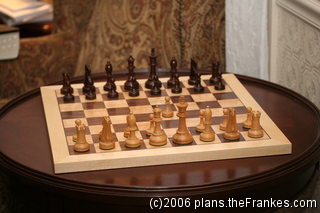
This is Part 1 of a 15-page tutorial (in three parts) that will show you how to build an heirloom-quality, all-wood chess or checkers board with just a few small pieces of lumber. (Use the page navigation at the bottom of each post to change pages within each part.)
This part covers planning through first layer glue-up. You can also:
- Skip to Part 2 (5 pages), which covers cutting the squares through planning the inlay.
- Skip to Part 3 (4 pages), which covers cutting the inlay through finishing.
- See a gallery of reader-built chess boards here: Reader-built Chess Boards
[ad#Chess Content Banner]
This is a great project for using up some small, otherwise unusable pieces of wood you may have laying around your shop. It’s very easy to build even with woodworking hobbyist tools, and it doesn’t consume a lot of expensive wood. The method described here will result in a handsome board with perfectly aligned squares, a sophisticated (but simple) inlay, and a polished finish.
Tools Used For This Project
- Pencil
- Hand plane
- Yellow wood glue
- Six 24-inch bar clamps
- Four C-clamps
- Ryobi BT3100 table saw (with router table attachment)
- Shop-made crosscut sled
- Glue brushes
- Grizzly 14” band saw
- Chisel
- Ryobi handheld belt sander
- Dewalt handheld router
- Pattern router bit
- Combination square
- Porter-Cable 557 biscuit jointer
- Tung oil finish
- Wax finish
- Clean cloth rags
- Small human buffer (you’ll see…)
[ad#Chess Content Banner]
Square Sizes
If you already have a chess set, the first step is to measure the diameter of the base of the largest piece (typically the king). This measurement will usually range from 1.5 to over 2 inches, and should be considered when planning the size of the board and its squares. My favorite set has kings with a base width of 1.75 inches, which look very nice on 2-inch squares. This square size will (obviously) dictate the overall size of the board, as well as the sizes of lumber you’ll need. In this tutorial we’re building a board with 2-inch squares. This means that the inside of the board (where the squares are) will measure 16 by 16 inches.
The Strategy
We want to make good, efficient use of expensive wood, and want the board to stand the test of time. We don’t want to have to cut out 64 identical and perfect squares, so we’ll build the center of the board using two pieces of wood, one light and one dark, glued edge to edge. Then we’ll resaw the glued pieces into four thin slices and glue them up, edge to edge, onto a 1/8-inch plywood sheet. We’ll then slice that sheet into eight strips and glue the strips onto a piece of 1/2-inch plywood. Then, we’ll trim the edges and add a solid wood frame to surround the squares. Don’t worry if it’s hard to picture how this comes together – it’ll be illustrated completely in this article.
Determine the Stock Size
We know the inside of the board will be 16 inches square. Because we’ll have to make at least seven cuts (probably more like nine) to cut our eight squares in each direction, we should select pieces of wood long enough to accommodate these cuts. So, add at least an inch if you’re using a standard 1/8-inch table saw blade. For this board, I chose stock that was 17.5 inches long, about 2.125 inches wide, and about 0.75 inches thick – one piece of dark wood and one light.
[ad#Chess Content Banner]
Selecting Wood for the Squares & Frame
The “white” squares in chess boards are usually made from maple, but sometimes ash or other light colored boards. The “black” squares can be any number of wood species, including black walnut, mahogany, teak, rosewood, ebony or more. Wipe the pieces down with a damp cloth and hold them next to each other to get a good idea of how they’ll look together. I used walnut because I happened to have some perfectly sized scraps on hand. For the frame, stick with one of the same species of wood that you used for the squares. A lot of boards out there use the darker wood as the frame, but I prefer the lighter instead.
Getting Started
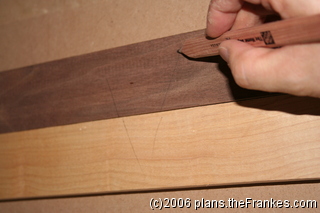
Once you’ve found a couple pieces of wood that look good together, mark them with a triangle so you’ll be able to reorient them when you glue them up.
Jointing the Edges
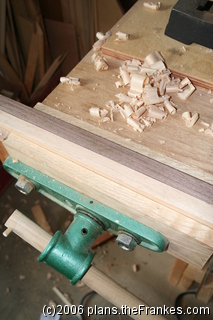
We’re going to edge glue these boards, cut them into slices, and then edge glue the slices, so it’s important that we have absolutely flat edges, and that each board is identical and consistent in width. It doesn’t have to be exactly 2 inches wide, but both boards do have to be exactly the same width or the squares won’t line up perfectly. There are a number of ways you can accomplish this, depending upon the tools you have. One option would be to run the edges first over a jointer, then through a thickness planer. Another option would be to use a hand plane and then a table saw. I actually fastened both pieces together (face to face) in a vise and used a hand plane for the inside edges until they were perfectly flat, and then I ran both pieces through a thickness planer until they were exactly the width I needed.
[ad#Chess Content Banner]
First (of many) Glue-ups
Spread out a piece of wax paper to protect your table from the glue squeeze out, find your alignment triangle, and then ready the pieces for gluing by cleaning them. Do not use biscuits, dowels, or anything else to strengthen this joint! Apply an even spread of glue to one edge, and then press them together and clamp.
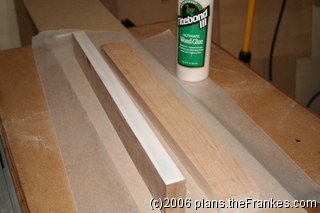
It’s okay if the boards have slightly different thicknesses at this point. The most important thing here is that the edges meet together across their lengths for a tight fit.
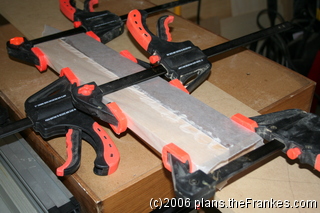
Now wait for the glue to dry. There’s nothing strengthening this joint, so give it a good 24 hours to be sure the glue is cured.
[ad#Chess Content Banner]
Cutting the Slices
There are a couple of ways you can to this. With the first method, you set up the fence twice: once for the initial cut, and a second time for cuts two and three. If you want to set up the fence only once, you can do a little more math. Using the minimum width of the boards and the thickness of the blade, you can calculate exactly how wide each slice needs to be, set up the fence once, and then cut three slices. I prefer the method I describe below. Using a band saw, stand the glued piece up on end and resaw (or slice) it in half. It doesn’t have to be exact, because you’re going to be sanding the entire board flat, but the more accurate you are when cutting these slices, the more time you’ll save sanding. You’ll end up with two slices, each about 3/8 of an inch thick.
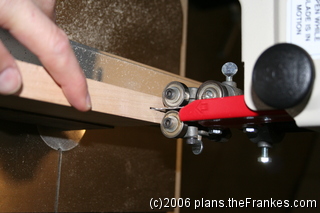
At this point, you can flatten each of the rough sides with a planer, jointer, or sandpaper. In fact, it’s common when resawing like this to flatten just one of the rough sides a bit for better adhesion when gluing the slices down. If you do this, take off just enough wood to make it reasonably flat, and do so always on only one side – the side that will be glued down. You’ll clean up the other side later after all the slices have been glued. I prefer to just leave them rough at this point and clean them up by sanding them later. Next, reset the band saw fence and cut each of these slices in half again.
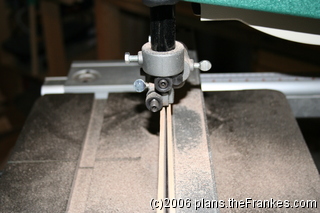
Use a push stick so you don’t saw your fingers off.
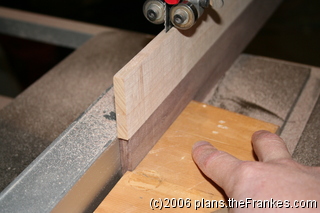
When you’re finished, you’ll have four slices: each half dark and half light, and each exactly the same width. Again, it’s okay if the cuts are a little rough or the thickness varies slightly. What you’re concerned about here is having perfect edges and perfect widths, and because you cut them all from the same glued-up boards, these slices will be perfect in that regard.
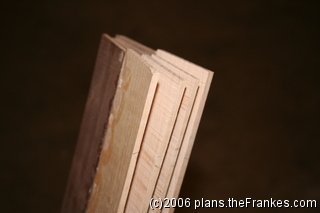
Line up the slices in the order you cut them, and either draw another alignment triangle or number them 1 through 4. This will help you remember how to glue them up.
[ad#Chess Content Banner]
First Layer Glue-up
Prepare the bottoms of the slices by sanding them down nearly flat so they can be glued solidly to a backer board. Then, cut a piece of 1/4-inch plywood just larger than your board dimensions. (E.g., If you’re making 2-inch squares, cut the 1/4-inch plywood to about 16.5 inches.) Here I’m using a small crosscut sled to make these cuts, but you can cut it against the fence just as easily.
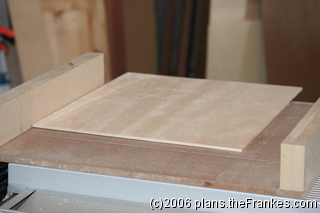
Orient the grain of the backer board to be perpendicular to the grain of the slices and glue the first slice down so that its edge is exactly adjacent to one edge of the 1/4–inch plywood sheet. I use my crosscut sled for this: First put down some wax paper to protect the sled, then clamp the backer board against one edge of the sled. Then apply the glue to the slice and clamp it, too, against the edge of the sled, and also firmly to the backer board. Thin slices tend to bow a bit because a thin board cannot resist the force of the grain as well as a thick one. So, to provide good clamping pressure, use a couple of long pieces of hardwood along the length of the slice on the both edges and in the middle where the two wood species are joined. (See photo below.) Then wait for the glue to dry. You’ll be clamping the rest of the slices against this first slice, so allow a good 24 hours for the glue to cure. Next, use a glue roller or brush to prepare the second piece and clamp it into place.
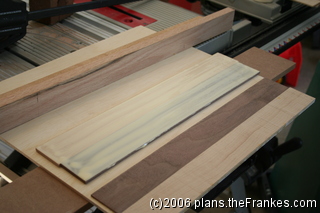
Spread the glue evenly on the back of the slice and along the edge that will be pressed up against the first slice. Flip the piece over and clamp it into place. Again, use cauls where you need to if the slice has bowed slightly and to provide good clamping pressure.
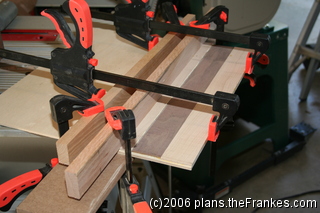
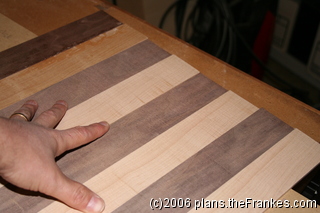
Allow the glue to set for a couple of hours, then proceed with slices three and four. When you’re finished, you’ll have a dark and light striped board.
This is the End of Part 1. You can:
- Skip to Part 2 (5 pages), which covers cutting the squares through planning the inlay.
- Skip to Part 3 (4 pages), which covers cutting the inlay through finishing.
[ad#Chess Content Banner]
Genius. Thank you!
Hi! I’ve been skimming this forum for a bit – Decided to contribute=)
I’ve been doing this for my year 10 major project, works like a charm. Very simple to follow, very effective and my teacher wants to add it in a woodshow. THANKYOU SO MUCH!!!
That’s great — I’d love to see some pictures when you’re finished!
I’ve been building checkerboards for years, but I make them a full 3/4’s thick. I don’t use a backer. I just finish both sides. I add one step that gives strength and gives a nice look. I glue up the dark wood in a panel 16 inches wide and cross-cut my strips from this piece. That turns the light and dark squares grain the opposite of each other. I think it is worth the trouble.
Tha sounds great, Stan. I’d love to see a photo if you have a chance!
I want to build a chess board for my sweetheart…he loves chess. But the terminology here is beyond me. I don’t have a shop and my experience with crafts is, painting and finishing tables or staining old wood furniture…am I in over my head? I’d really like to do this, but I’m a little nervous looking at the list of needed materials.
Kema
I think the table saw and the band saw where probably the most specialized tools that I used for this. Do you have any access to those tools via friends or family members? If you can get the cuts made at least, then I think you’d be pretty comfortable with the rest of it — the gluing up, sanding, and finishing. You sound pretty crafty, though, so you might consider stepping up to some woodworking tools if you have the opportunity! 🙂
I think it’s cheaper to just buy a board, but if you’re handy and love wood glue I guess it could be a fun project! 🙂
This would actually be a great birthday idea. Making something meaningful with your own hands is always the best gift.
James
I assembled your great chess board. I put the thin strips on a piece of plywood and spread the glue around with a roller. Clamped the whole thing together and used the board for about a year. After a year the corners on one started turning up. I know this is from moisture and I used elmer’s glue, and spread the whole thing with rollers. I also ensured the edges were glued and clamped before hand.
Before they started turning up the board was nice and flat, very discouraged.
Hi Ted. I’m not quite sure I understand where the thin strips were or what went wrong. All my chess boards have held up nicely over the years. If you can post a picture I might be able to help you. Are the strips you’re talking about the rows of black/white squares, or some sort of edging material on the outside of the plywood edges? Did you use wood glue to attach them? What kind of finish did you put on the board?
The strips are the rows of black and white, yes. It did not occur to all the rows, which I understand says its the glue, but the problem is I used a roller and was very careful to ensure it was thorough. It is in a room that in the summer gets humid and cold in the winter. The finish was polyurethane, oil based, floor variety. You can not see it in the picture because it is slight. You can clearly feel it and change it by pushing it down. The glue was Elmer’s wood glue.
Yes, the thin strips are the rows of the squares. Only a couple are lifting and you can push them down. A picture will do little good as the rise is slight, but noticeable to the eye.
The glue was Elmer’s wood glue.
The finish is oil based polyurethane the type you use on floors.
The room is humid in the summer and cold in the winter. But in the winter on the weekends it does go from 61 to 68.
I did use a glue roller so I understand that a few rows lifting points to the glue, but I was careful to ensure complete coverage and I did use a roller. My thought ws because Elmer’s is not moisture resistant that wa the problem. What do you think?
Yeah, the wood will want to expand and contract with the humidity and the plywood will not. I suppose it’s possible that the glue failed if it’s not moisture resistant, but I haven’t actually seen problems like this with the thin veneers of black/white squares — even when I was making them with original Titebond (also not moisture resistant). It’s also possible that one of the plywood laminates itself failed — for example if there was a void in the plywood on or near one of the edges that is coming up. In this case the top layer of plywood might actually still be sticking to the squares.
The other thought I has was in surface preparation and glue-up, but it sounds like you were probably pretty careful there. For example, if there’s dust, poor coverage, or poor clamping over a spot, then that can cause it to be weakened as well.
I saw a kit somewhere that includes a needle you can use to get in there and re-glue veneers down. I wonder if that might help solve the problem… Let me look and see if I can find that again later tonight.
Greetings. Well the gathering went very well, all 17 family members (down my side of the tree) were at our place for the better part of the week (the meals were both a challenge a highlight). The chess boards were very well received, there are video and pictures on Facebook, but I do not know how to make them available to you, I am just now getting my feet wet in that environment. #2 son has posted pictures with a most beautiful set of men he bought for his board.
Please continue with your plan to post the pics, etc. and I will notify the boys.
Thanks again,
Dennis
I just finished a Chess Board using the following types of wood, chestnut,oak,mahogany, black walnut, maple, BW